
Why Beer Becomes Lightstruck: The Science Behind Skunky Beer and Green Bottles
Ever wondered why some beers smell like a skunk? It isn't an accident—and it isn't just part of the beer's personality. Learn what causes lightstruck beer, why bottle color matters, and how a few minutes of sunlight can permanently change a beer's aroma.
Short Answer
Beer becomes lightstruck when ultraviolet (UV) light reaches the beer and reacts with hop compounds called iso-alpha acids.
That reaction creates a sulfur-containing compound called 3-methyl-2-butene-1-thiol (MBT).
Humans can detect MBT at incredibly low concentrations, giving beer the unmistakable aroma often described as skunky.
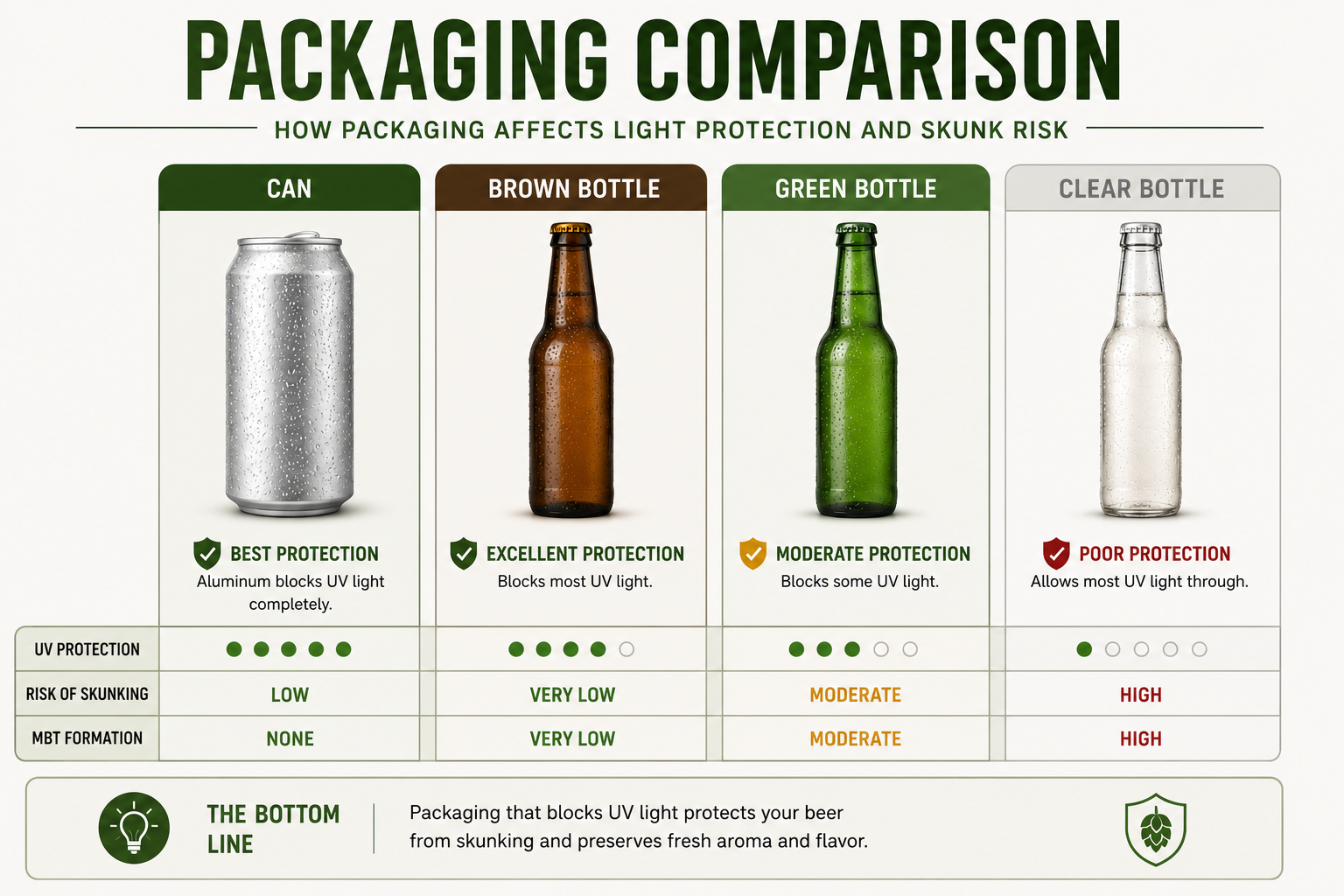
Bottle color makes a tremendous difference:
Brown bottles block most UV light.
Green bottles allow much more UV light through.
Clear bottles provide almost no protection.
Cans and kegs block all light, essentially.
The beer recipe hasn't changed.
The aroma has.
What Does "Lightstruck" Mean?
Beer doesn't become skunky because it has spoiled.
It becomes skunky because light starts a chemical reaction.
Brewers call this defect lightstruck because exposure to ultraviolet light "strikes" certain hop compounds and changes them into something entirely different.
The result isn't subtle.
Many people recognize it immediately—even if they don't know what they're smelling.
If you've ever opened a beer and thought it smelled like:
skunk
burnt rubber
sulfur
cannabis
roadkill
there's a good chance you're smelling MBT.
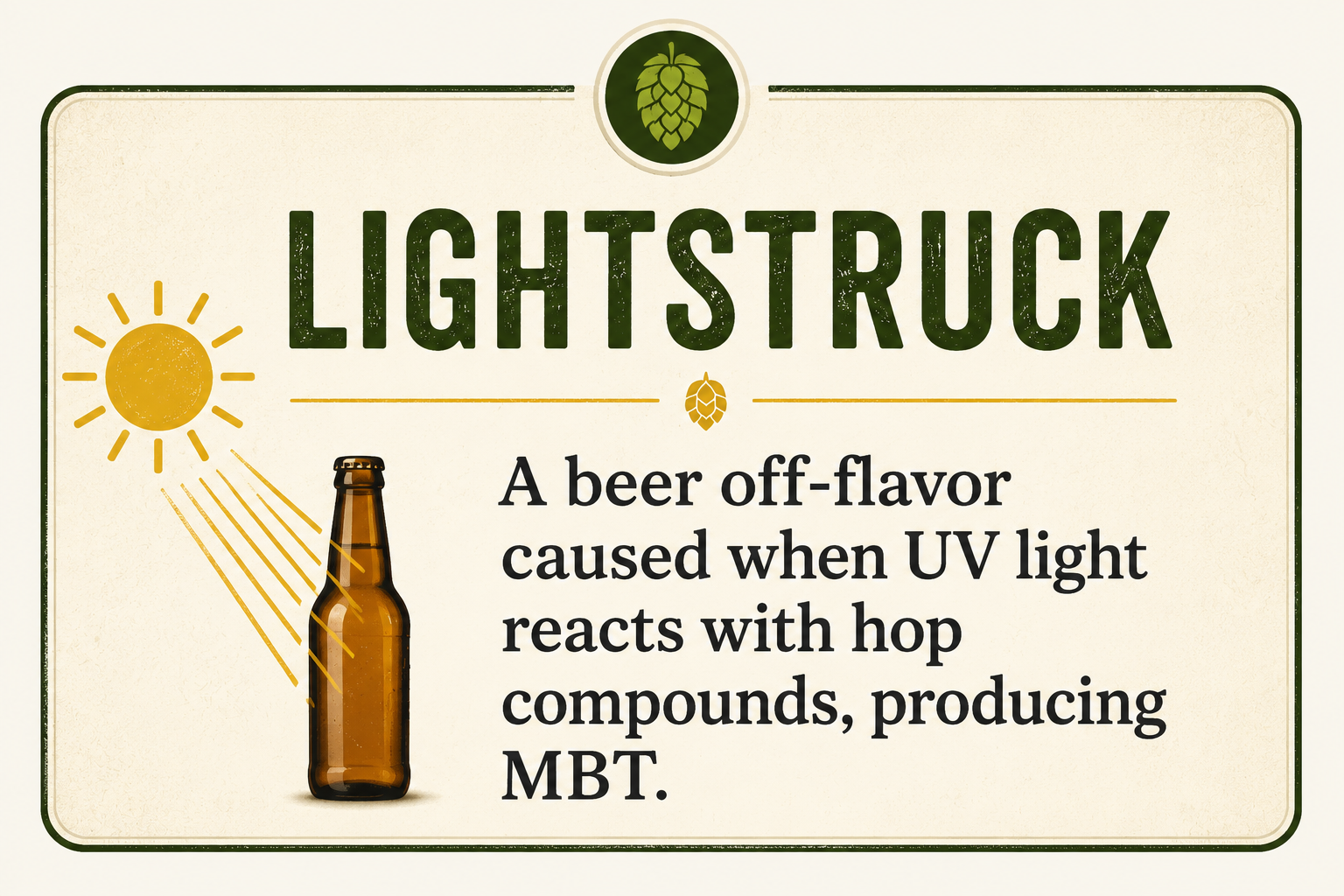
Lightstruck is a beer off-flavor that occurs when UV light reacts with hop compounds, producing the sulfur compound MBT, which creates the characteristic skunky aroma.
The Chemistry (Without Making It a Chemistry Lesson)
Here's the simplified version.
When hops are boiled, their alpha acids become iso-alpha acids.
These compounds are responsible for much of beer's bitterness.
When ultraviolet light reaches those iso-alpha acids, they break apart.
One of the products formed is:
3-methyl-2-butene-1-thiol (MBT)
MBT belongs to a family of sulfur compounds called thiols.
Many thiols have incredibly low sensory thresholds.
MBT is one of the most potent aroma compounds known in beer.
You don't need very much.
At all.
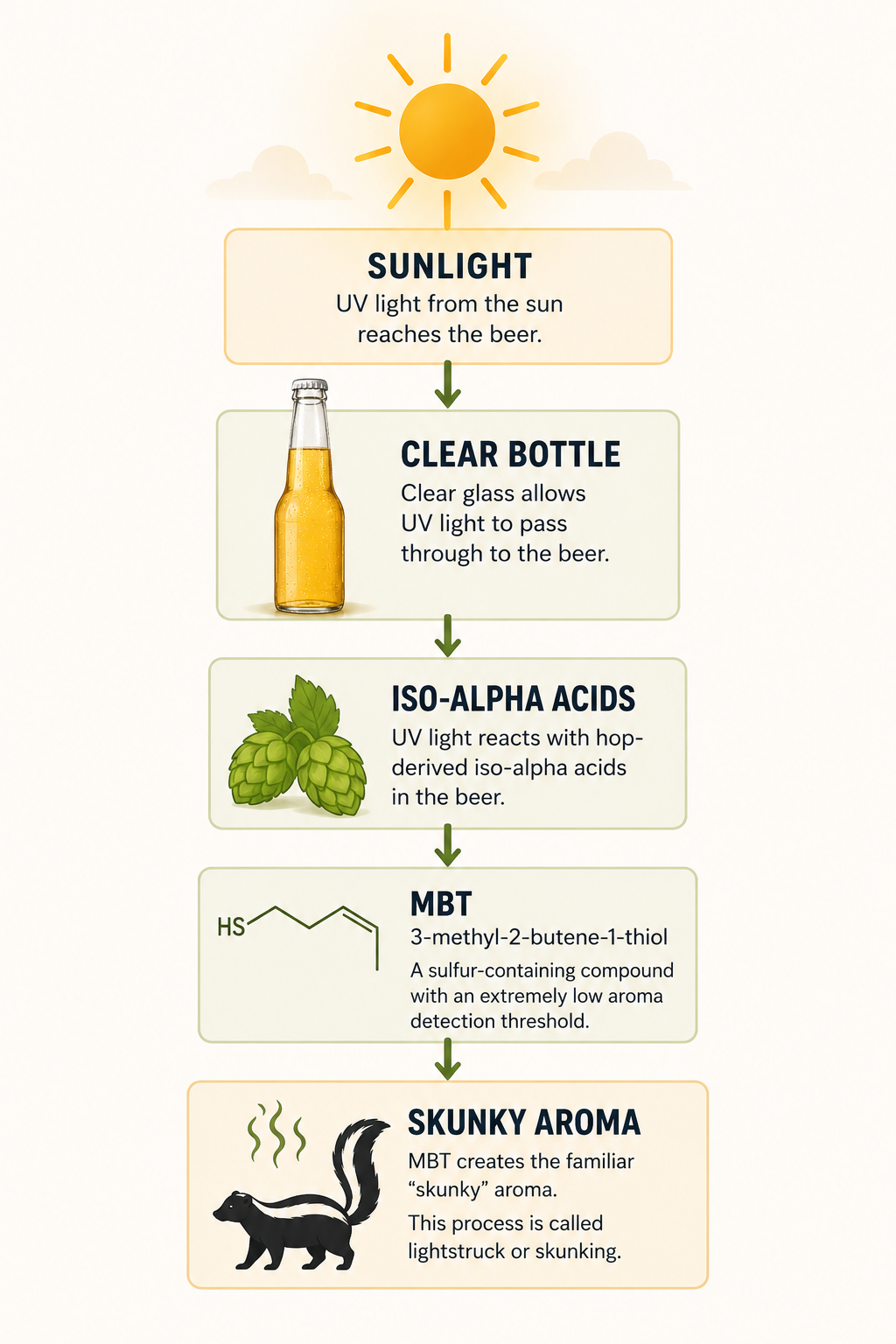
Infographic showing how sunlight causes beer to become lightstruck. The flow follows sunlight reaching a clear bottle, UV light reacting with iso-alpha acids to form MBT (3-methyl-2-butene-1-thiol), resulting in the characteristic skunky aroma.
Why Does It Smell So Strong?
One fascinating part of MBT is how little it takes.
Humans can detect it at concentrations measured in parts per trillion.
That means only tiny amounts are needed before many people notice it.
Think about perfume.
One drop fills a room.
MBT behaves similarly.
A microscopic amount can dominate the entire aroma of a beer.
That's why a beer can taste mostly normal while smelling overwhelmingly skunky.
Why Bottle Color Matters
Not all bottles protect beer equally.
Brown bottles
Brown glass blocks most of the UV wavelengths that create MBT.
It's the preferred glass color for preserving hop character.
Green bottles
Green glass blocks some UV light—but nowhere near as much as brown glass.
Light can still reach the beer and create MBT.
Clear bottles
Clear glass provides very little UV protection.
Beer in clear bottles can become lightstruck surprisingly quickly if exposed to sunlight or certain indoor lighting.
Cans and kegs
Metal blocks light entirely.
No UV reaches the beer.
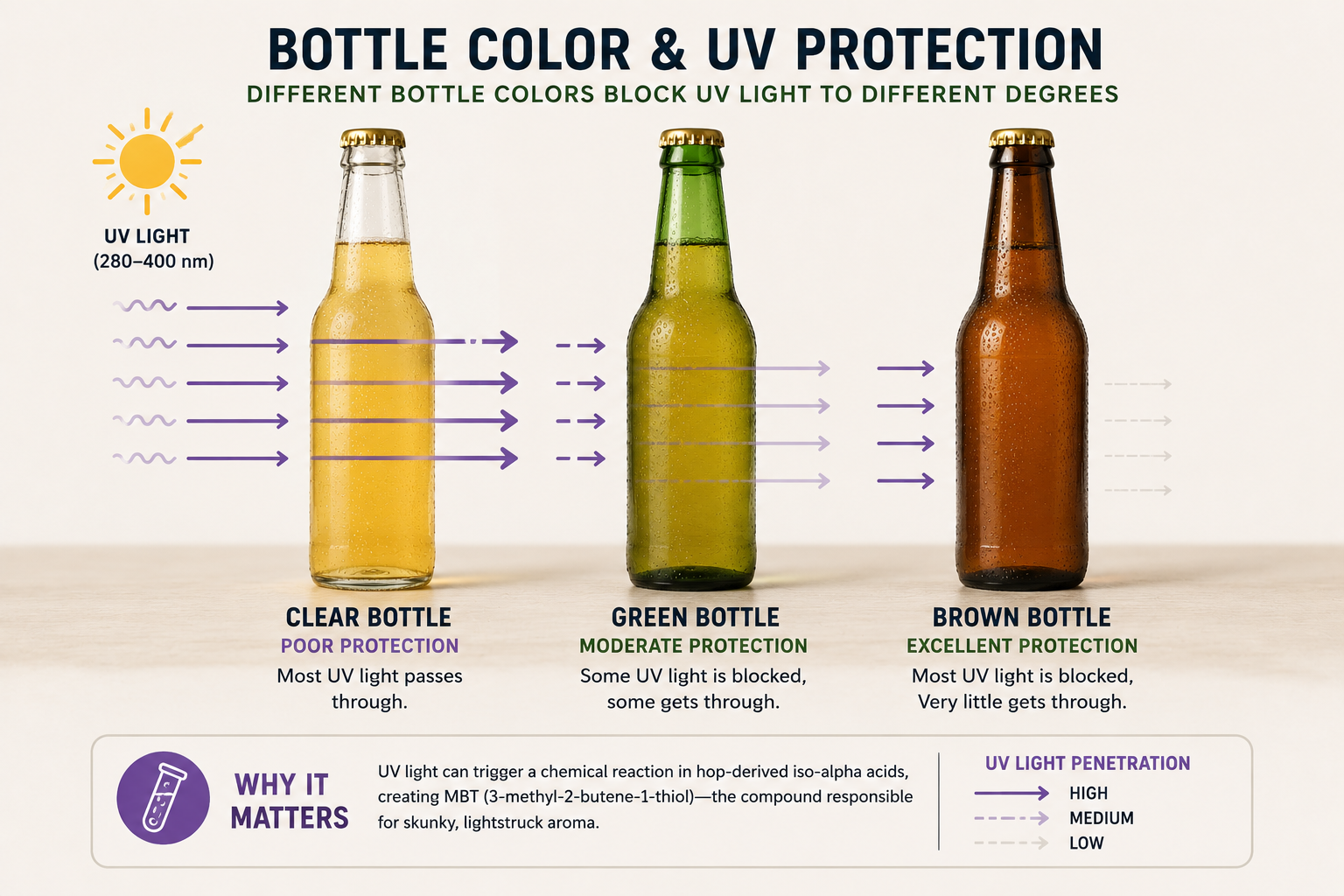
UV protection by bottle color. Clear bottles allow the most ultraviolet light to reach beer; green bottles provide moderate protection, and brown bottles block most UV light. Because UV light triggers the formation of MBT—the compound responsible for lightstruck or "skunky" aroma—beer packaged in brown bottles is much less likely to develop this off-flavor than beer packaged in clear bottles.
How Fast Does Beer Become Lightstruck?
Faster than many people realize.
Under direct sunlight, noticeable lightstruck character can develop in minutes.
Even fluorescent lighting can contribute over longer periods.
The exact timing depends on factors including:
light intensity
exposure time
bottle color
hop composition
beer style
Once MBT forms, it doesn't simply disappear.
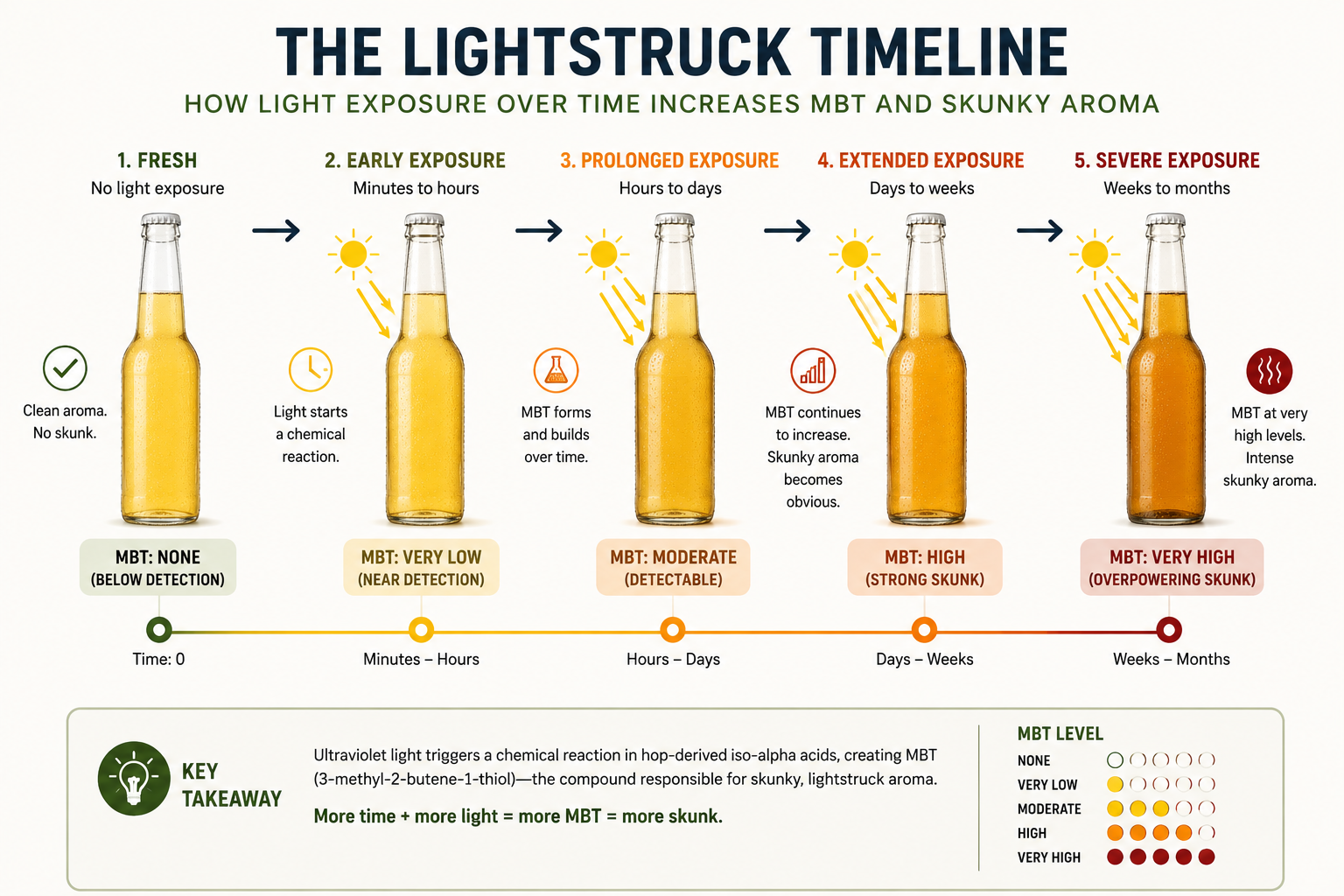
Formation of lightstruck aroma over time. As beer is exposed to ultraviolet (UV) light, hop-derived compounds gradually form increasing amounts of MBT (3-methyl-2-butene-1-thiol), the compound responsible for skunky aroma. More light exposure generally leads to more MBT and a stronger lightstruck character.
Why Do Some Breweries Still Use Green or Clear Bottles?
It's a fair question.
If brown bottles protect beer better, why doesn't every brewery use them?
The answer is usually branding.
Certain beers have become strongly associated with their packaging.
Consumers recognize them immediately on store shelves.
Some breweries also use specially modified hop extracts that greatly reduce the formation of MBT.
Those products help—but they don't eliminate every possible source of light damage in every beer.
Does Lime Prevent Skunking?
No.
Adding lime doesn't stop MBT from forming.
The chemical reaction has already happened.
What lime can do is temporarily cover some of the skunky aroma with bright citrus oils.
That's one reason lime is commonly served with clear-bottled lagers.
It changes what you smell—not what happened to the beer.
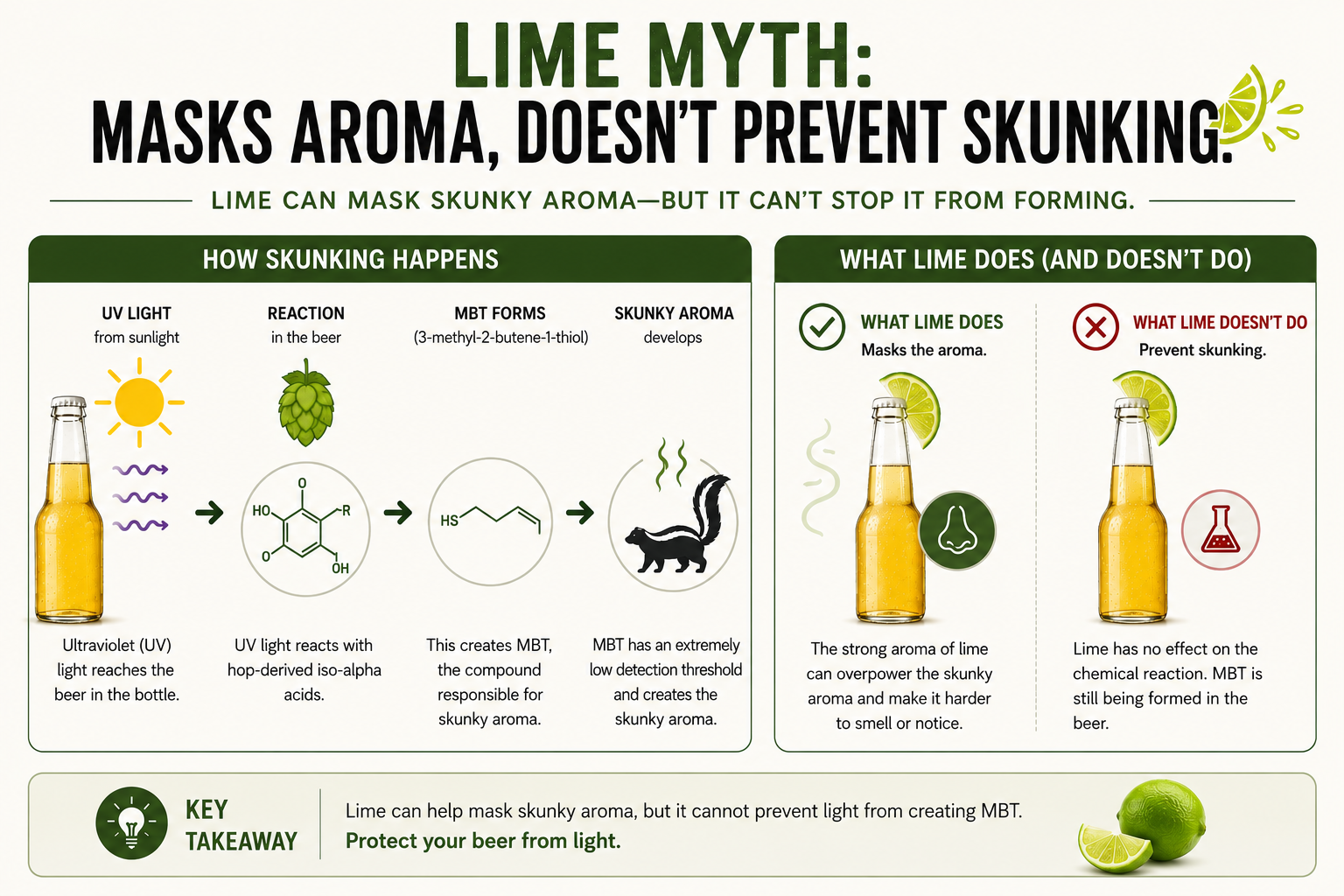
Lime can reduce the perception of skunky aroma by adding a strong citrus scent, but it does not prevent the chemical reaction that forms MBT (3-methyl-2-butene-1-thiol). Once a beer has become lightstruck, lime may mask the aroma, but it cannot reverse or prevent skunking.
Can You Taste the Difference?
Absolutely.
One of my favorite demonstrations is comparing the same beer packaged differently.
For example:
Corona Extra (clear bottle)
Corona Familiar (brown bottle)
The recipes are remarkably similar.
Yet the aroma can be dramatically different simply because one package protects the beer from UV light much better than the other.
Without the lightstruck aroma dominating the glass, more of the beer's original malt and hop character becomes noticeable.
It's an excellent reminder that aroma plays an enormous role in flavor.
How to Avoid Lightstruck Beer
Fortunately, prevention is simple.
Choose:
cans
brown bottles
beer stored away from bright light
Avoid leaving beer:
in direct sunlight
in hot car windows
under bright retail lighting for extended periods
Good storage protects aroma just as much as freshness.
Frequently Asked Questions
-
Yes.
It isn't harmful.
The aroma simply changes.
-
No.
Cold temperatures slow many reactions, but UV light can still produce MBT.
-
Somewhat.
It's much better than clear glass but significantly less protective than brown glass.
-
Yes.
Some fluorescent and LED lighting emits wavelengths capable of contributing to lightstruck character, although sunlight is generally much more intense.
The Bigger Lesson
Lightstruck beer is a perfect reminder that flavor isn't determined only by a brewer's recipe.
Packaging matters.
Storage matters.
Aroma matters.
Changing just one variable—the amount of light reaching the beer—can completely change how we experience it.
Once you notice it, you'll never look at a clear bottle quite the same way.
Continue Exploring Beer Sensory Science
Why Does Corona Taste Skunky?
See how packaging affects one of the world's most recognizable beers.
Corona Familiar vs. Corona Extra: What's the Difference?
Compare two nearly identical beers with dramatically different sensory experiences.
Aroma: Explore the Wheel Beer Master Kit
Train your nose to recognize common beer aromas.
About the author: Jen Blair is a Master Cicerone®, Master BJCP judge, beer educator, and sensory specialist. She develops practical tools for learning how beer flavor works and how to evaluate it more clearly.